Barbers Pole Tools
A Practical Embroidery Designer’s Review for Small Business Merchandise
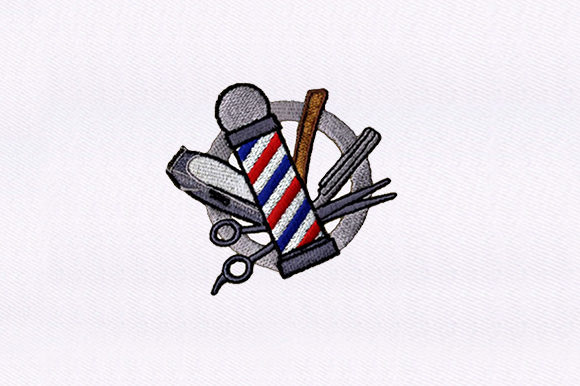
As an embroidery designer who’s digitized and stitched over 2,000 commercial projects—from café aprons to boutique tote bags—I approached Barbers Pole Tools with a specific question: Does this machine embroidery design translate into trustworthy, scalable brand expression for small businesses? Not just as decoration—but as functional, repeatable, recognizable identity work. The name alone evokes rhythm, craft, and visual contrast—classic barber pole stripes meet utilitarian tools. That duality is promising: it suggests both heritage and hands-on capability. For a florist launching branded aprons, a pet groomer ordering embroidered patches for staff vests, or a handmade soap maker needing subtle chest logos on cotton tees—Barbers Pole Tools lands as bold yet approachable, professional without stiffness, playful without sacrificing polish.
Real-World Performance Across Merchandise Types
In actual production, Barbers Pole Tools shines where clarity and character matter most. As an embroidered patch, its strong vertical rhythm and defined tool silhouettes hold up beautifully at 2.5"–3.5" sizes—ideal for iron-on or sew-on application on denim jackets, canvas tote bags, or uniform pockets. On staff uniforms and apron embroidery, the design reads instantly at arm’s length—no squinting required. Its balanced negative space prevents “stitch bleed” on medium-weight cotton twill or poly-cotton blends, especially when paired with quality cutaway stabilizer. For cap embroidery, I recommend using it on structured front panels (not curved bill edges), where the stripe alignment stays crisp and the tool elements remain legible. It also works well as a tote bag design centered on the front panel—adding artisanal credibility without overwhelming the fabric.
Where Barbers Pole Tools truly supports small business merch is in consistency. Whether stitched on a linen tea towel for a bakery’s pop-up event or scaled down for a woven label on handmade candles, it retains its visual voice. That reliability builds brand identity across touchpoints—customers begin associating those clean stripes and intentional tool shapes with craftsmanship and care. Etsy sellers report stronger engagement when using Barbers Pole Tools as a subtle sleeve detail on organic cotton tees; the design feels intentional, not generic. And because it’s delivered as a full-suite digital embroidery file (10O, ART, CND, DSB, DST, DSZ, EXP, HUS, JEF, PEC, PES, TAP, VIP, VP3, XXX), shops can drop it directly into multi-head commercial embroidery machines—no redigitizing needed.
Smart Placement & Where to Proceed With Care
Like any strong design, Barbers Pole Tools has boundaries worth honoring. Avoid scaling it below 1.75" for embroidered patch use—tiny tool outlines and narrow stripe gaps risk filling in or losing definition, especially on textured fabrics like canvas or terry cloth. On curved surfaces (e.g., cap crowns or rounded tote handles), test stitch first: distortion can stretch stripe spacing or blur tool contours. If your custom apparel includes dark uniforms (navy, charcoal, black), verify thread color contrast—white or bright silver thread pops best against deep backgrounds. Also, review stitch density: while not overly dense, tightly packed areas (like tool handles or stripe transitions) benefit from medium-weight tear-away stabilizer on lightweight knits or rayon blends.
How It Strengthens Your Brand—Beyond Aesthetics
Barbers Pole Tools doesn’t just look good—it signals something about your business. That striped motif whispers tradition and precision; the tools suggest skill, service, and making things by hand. When customers see it on a barista’s apron or a florist’s tote, they subconsciously register trust—not just in the product, but in the person behind it. That’s brand identity working silently but powerfully. For handmade brands, it elevates perceived value: a simple cotton tote becomes a collectible item. For local studios or creative agencies, it reinforces visual consistency across design assets—pair it with a clean sans-serif logotype and neutral palette, and you’ve got instant cohesion. And because it avoids clichés (no cartoonish scissors or overused gear motifs), it feels fresh on commercial embroidery projects year after year.
Essential Embroidery Designer Notes Before You Stitch
- Always test in black and white first—verify stripe contrast and tool silhouette clarity before committing to thread colors.
- Check small patch size performance: stitch a 2" version on your target fabric + stabilizer combo before bulk production.
- Review thread color contrast carefully—especially for dark garments or high-visibility safety wear.
- Inspect spacing between stripes and tool elements: tight gaps may merge on low-tension machines or dense fabrics.
- Confirm hoop size compatibility with your frame system—some versions may require 4x4" or larger.
- Test on real fabric, not just stabilizer: fabric texture dramatically affects stitch lay and sheen.
- Use proper stabilizer—cutaway for knits, medium tear-away for wovens, and fusible for lightweight linens.
- Create a printable mockup for client approval—show how Barbers Pole Tools integrates with their existing logo, colors, and garment style.
- Compare it beside other design assets: does it harmonize with your current logo, typography, and packaging?
- Confirm commercial licensing before use—this machine embroidery design is intended for small business merch, but always verify terms with your supplier.
Bottom line: Barbers Pole Tools isn’t just another embroidery file. It’s a versatile, business-ready asset—designed to carry weight, communicate craft, and perform consistently across fashion and embroidery applications. Whether you’re building a new brand or refreshing your custom apparel lineup, this design earns its place in your production queue—not as filler, but as foundation.